AI puts workforce strategy on the executive agenda
12 November, 2026
How will AI reshape people and talent in specialty insurance?
For many specialty insurers, strategic workforce planning has rarely been an executive-level challenge. Roles changed slowly and careers followed familiar paths, so recruitment, training and succession planning were usually enough.
Offshoring moved work elsewhere and digitisation made tasks faster, but AI changes the work itself: what gets done, who does it and how people build the expertise to do it well.
The London Market Group and Oxbow Partners recently brought together 20 Chief People Officers from across the market (see here for a write-up). What we heard is that People teams are being asked to respond to potentially big shifts in roles, skills and workforce shape, often before management teams have decided what they want AI to do for the business.
The immediate business case for AI may support fewer junior roles (especially in a softening market), while the long-term talent need may require the opposite. A firm that cuts junior staff today to bank savings may not notice the damage until it needs its next generation of senior underwriters, brokers and claims leaders.
Building useful technology takes years, and so does developing an experienced insurance professional. Waiting for the technology to settle means starting too late: decisions about AI today are decisions about the workforce a firm will have in ten years. One participant summed up the difficulty:
“How do you argue the case for investment in people who will outlive your tenure? Most businesses are highly annualised, some even struggling to think beyond the next quarter.”
That makes this a question for the whole executive team, not something to delegate to the People team to tackle alone.
The impact of AI is not the same for everyone
Much of the debate is framed as if AI will reshape every role at the same pace. That is not the case.
In reinsurance and complex specialty lines, the core of the job changes less than the headlines suggest. Value still depends on judgement, relationships and an understanding of risk that is hard to codify, so AI mainly takes away preparation, data gathering and first drafts. As one participant put it:
“I always thought underwriters were technical, maths-based people. But when it comes down to it, they place less reliance on cold logic and more on gut feel, judgement and whether a risk just ‘feels right’.”
In operations and administration, the change is much bigger. Much of the processing, checking and re-keying that fills these roles can increasingly be done by AI. More standardised, higher-volume underwriting sits somewhere in between.
Some roles will shrink or disappear. Pretending otherwise doesn’t help anyone, including the people in those roles. Management teams need a specific view of where AI changes the work significantly and where it mainly makes good people more effective, rather than one programme applied across the business.
Understand the target state before you plan the workforce
Most workforce plans start with today’s organisation chart and project it forward. That does not work when the role itself is changing.
The optimal starting point is re-imagining the work, processes and technology in an AI-enabled world. Understand what activities AI should do, which it can support and which remain clearly human.
For example, Underwriting Assistant roles could change significantly. A large part of what UAs do today is exactly the kind of work AI handles well. As one roundtable participant put it:
“It’s not eliminating any roles, but it’s changing how people spend their time and where they focus.”
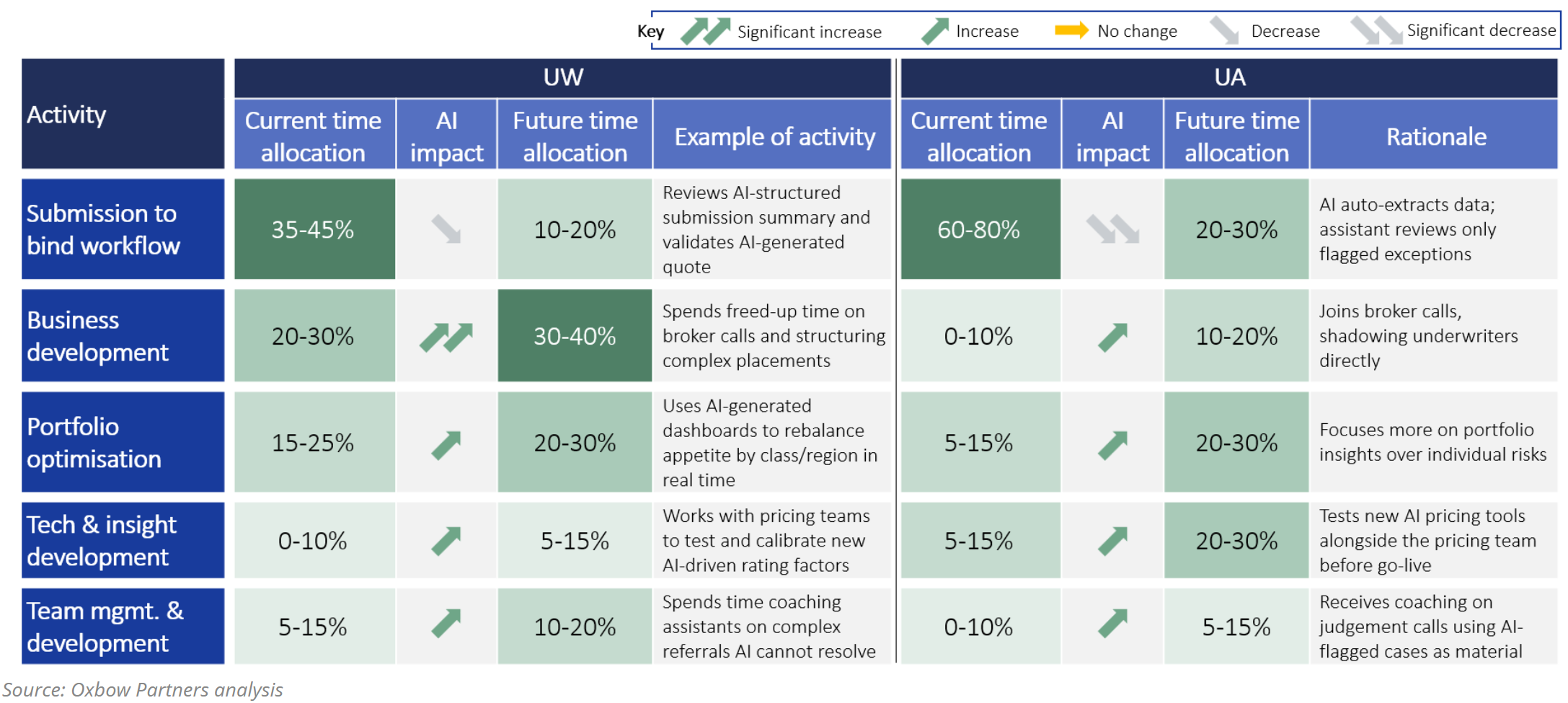
Our analysis suggests that position will be hard to hold. Over time much of the UA role as it exists today goes away, and what remains moves towards more typical underwriting and overseeing the AI tools that support it.
Underwriting assistants will see much of their current role done by AI
Future underwriting time allocation by activity
This also changes who insurers should hire. If AI takes on more procedural work, the qualities that matter more are curiosity, critical thinking, judgement, commercial sense, relationship-building and the confidence to challenge. Participants described:
“The pivot from functional competency to interpersonal competence, relationship building and development. The kind of (human) value add that doesn’t come from tech.”
One skill stands out: professional scepticism, knowing when not to believe the answer. But scepticism can’t be taught in a classroom. It comes from having seen enough risks go wrong.
Who trains the next generation?
In specialty insurance, judgement has always been built by doing the groundwork in the ‘apprenticeship model’: preparing submissions, checking data, handling straightforward cases alongside experienced colleagues. That groundwork is exactly what AI is best at removing, and it removes it far more completely than offshoring did. If firms no longer need people to do the groundwork, where will the next generation of insurance professionals come from?
The London Market is already exposed. LMG data shows that 24% of the market’s workforce is under 30 and on current hiring trends, that figure is projected to fall to 7% by 2034. At the same time, many of the market’s most experienced people are approaching retirement. As one attendee put it:
“The 7% will cost you next to nothing today, but they’re the ones on whom your future depends.”
The roundtable was clear that this is one of the issues people leaders worry about most, and one that management teams have barely started to address.
The uncomfortable answer is that firms may need to build some inefficiency back into careers on purpose. That might mean juniors working through a curated set of historical cases the hard way, or reviewing risks the AI has already assessed and explaining where they would disagree. It costs time, it looks inefficient on a spreadsheet, and it will frustrate people who want to move up the ladder quickly. But it is cheaper than finding in ten years that no one can challenge the model.
Running AI is a different skill from using it
It is tempting to treat AI as something (re)insurers build and the team learn to use. In practice, the bigger workforce requirement is learning to run AI.
Oversight itself is not straightforward. One participant warned:
“Multiple agents can produce outputs concurrently. The volume of review that’s required, risks creating cognitive overload and a sense of ‘overwhelm’”.
The real value lies in talent that improves AI capabilities over time, through better data insights, model performance and, ultimately, better decisions.
That needs people who understand both the insurance and the technology. Few (re)insurers have many people with those capabilities today.
We are already seeing the first versions of these roles: one firm places forward-deployed engineers alongside its underwriters, and others are bringing offshored technical roles back in-house. Further out, the roundtable discussed an ‘AI agent owner’ who designs, deploys and governs AI agents and is accountable for their oversight and performance.
A (re)insurer that waits for AI to be fully embedded before developing its people will find it has no one ready to use it.
Cost or capability: the choice for management
In our experience, we have not seen many (re)insurers talking about mass redundancies due to AI. Even so, it is hard to assume everyone will be redeployed. In much of the business, though, the bigger question is not which roles are no longer needed. It is what to do with the time AI gives back.
At the Insurance Insider London Market Conference on 11 November, Tracy-Lee Kus, Aon’s Co-CEO for EMEA, said Aon plans to use the capacity AI frees up to give clients better insight rather than to reduce headcount. Every management team will have to make its own version of that choice.
What next for management teams
There are some important decisions that only the executive team can make:
- Where will AI have the greatest impact and how does that differ across the business? Identify where AI will substantially change or remove work and where it mainly supports experts; recognise the difference between different functions.
- What does the AI-enabled target state look like, and which roles change or shrink as a result? Define the underwriter and UA of the future as part of that target state, and look beyond underwriting.
- How will expertise be developed once AI removes the old training ground? Replace the learning AI removes with deliberate career paths and apprenticeships, even if that means building some inefficiency back in; and recognise the value of professional scepticism.
- Who will build, run and improve AI, not just use it? Invest in the people who make the technology work, oversee it and improve it.
- Will the value from AI be taken as cost savings or reinvested in capability? Make that choice consciously and test the operating model against it.
AI will not make these decisions for anyone, and the People team cannot make them alone. The (re)insurers that come out ahead will treat workforce strategy as an ongoing management discipline and invest in people who may well outlive their own tenure.
Contributors and authors
Thank you to all of those who shared their perspectives and experiences through our roundtable discussion.
Miqdaad Versi, Partner. Miqdaad is a Partner in the Oxbow Partners London Office. He advises management teams at global specialty (re)insurers on strategy, transformation, M&A and operating model engagements. He authored Oxbow Partners’ 2024 report on Generative AI and has since worked with executives, leading engagements on a wide variety of AI and claims transformation programmes. He spends a lot of his time with clients in the US, Bermuda and the UK. Miqdaad started his career at Oliver Wyman and, before joining Oxbow Partners, held a range of operating and advisory roles, including leading the transformation of a small business in which he invested.