Growth in the soft market: What makes a specialty carrier special?
3 November, 2026
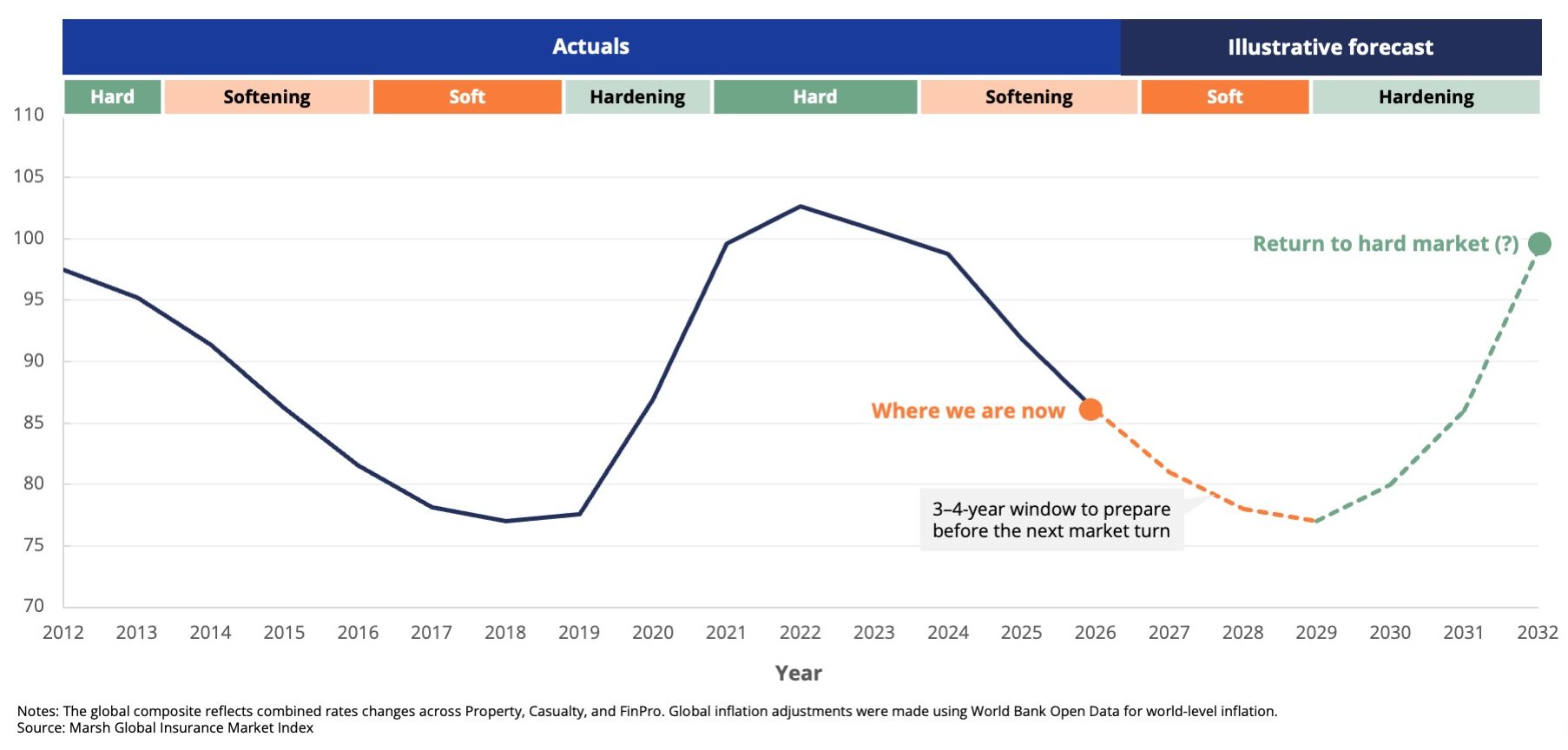
In the hard market, rising prices allowed carriers with very different capabilities to grow profitably. As conditions soften, capacity becomes commoditised. Brokers consolidate influence, underwriting and pricing discipline can slip, and third-party capital weakens the link between franchise strength and balance-sheet size.
The conventional carrier response to softening rates is to defend the book, tighten underwriting and wait for the cycle to turn. That is necessary but insufficient. A carrier that enters the soft market without a real edge will not create one merely by exercising more discipline. The real question for leadership teams is uncomfortable: “If our capital was removed from the market tomorrow, would brokers and clients genuinely miss anything?”. Every specialty carrier will need to prove that they are genuinely special.
Global composite insurance price index and illustrative forecast
(Inflation-adjusted, Q4 2011 = 100)
1. Use the soft market to strengthen the core
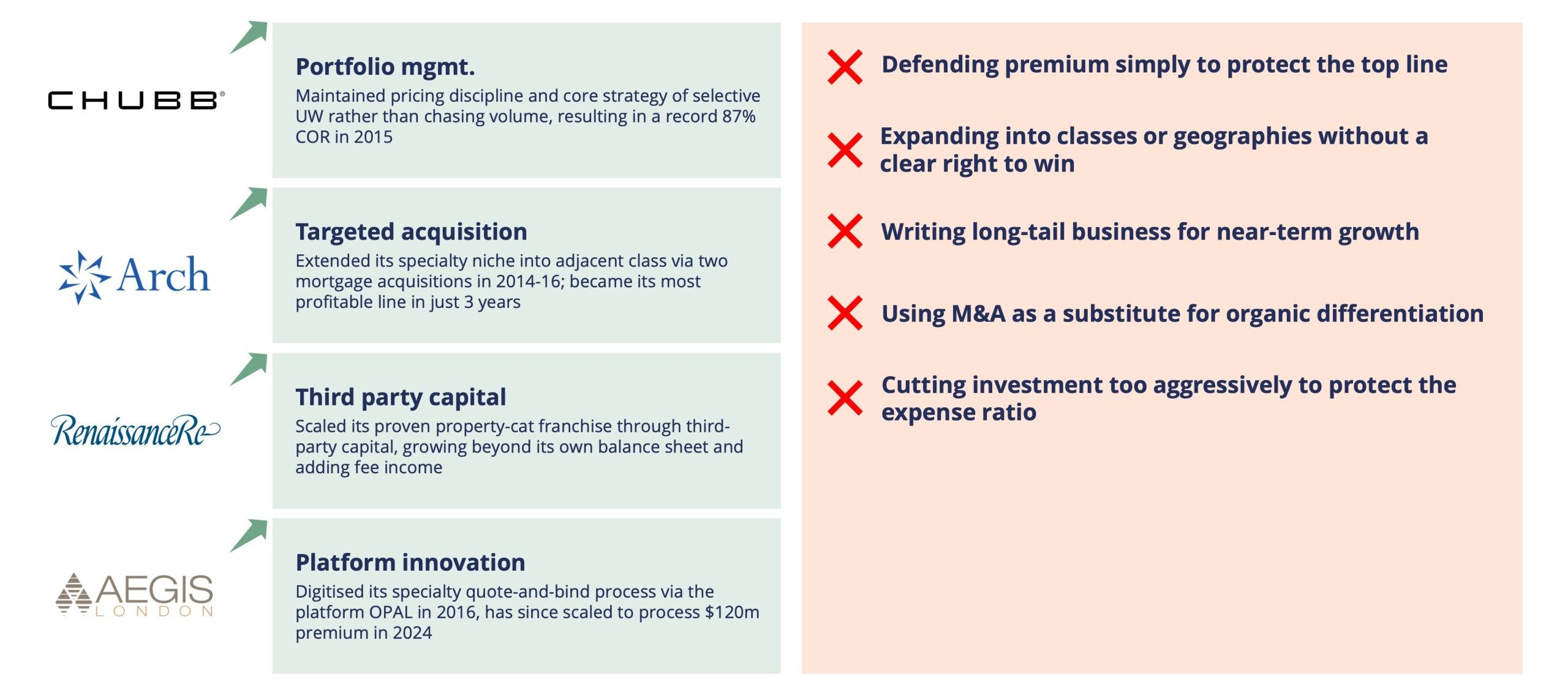
During the last soft cycle, many insurers adopted one of two approaches. Some went full defence: reduce exposure, protect this year’s result and wait for better conditions to start growing again. Others tried to reinvent themselves by entering new classes or geographies, increasing their share of the value chain, or embarking on an acquisition journey, with little regard for whether they have a genuine right to win in any of these areas.
The more successful carriers took a different approach: they used the soft market to reinforce an existing edge, investing behind businesses where they had a genuine right to win.
The soft market should be used to build the offence for the next hard market, reinforcing underwriting expertise, access to attractive business and an operating model capable of scaling as the market hardens.
Equally, it is important to resist the temptation to manufacture top-line growth by expanding into long-tail business without an underwriting edge. The apparent growth comes today; the consequences of weak underwriting may only become visible years later.
Growth built on an existing edge & what can go wrong
2. The market is not what it used to be
The strategic objective is always the same: access good risks, price them well and deploy capital profitably. However, recycling your playbook from the last cycle is unlikely to work during the next. Since the last soft cycle, the industry has changed in fundamental ways, creating a very different competitive landscape:
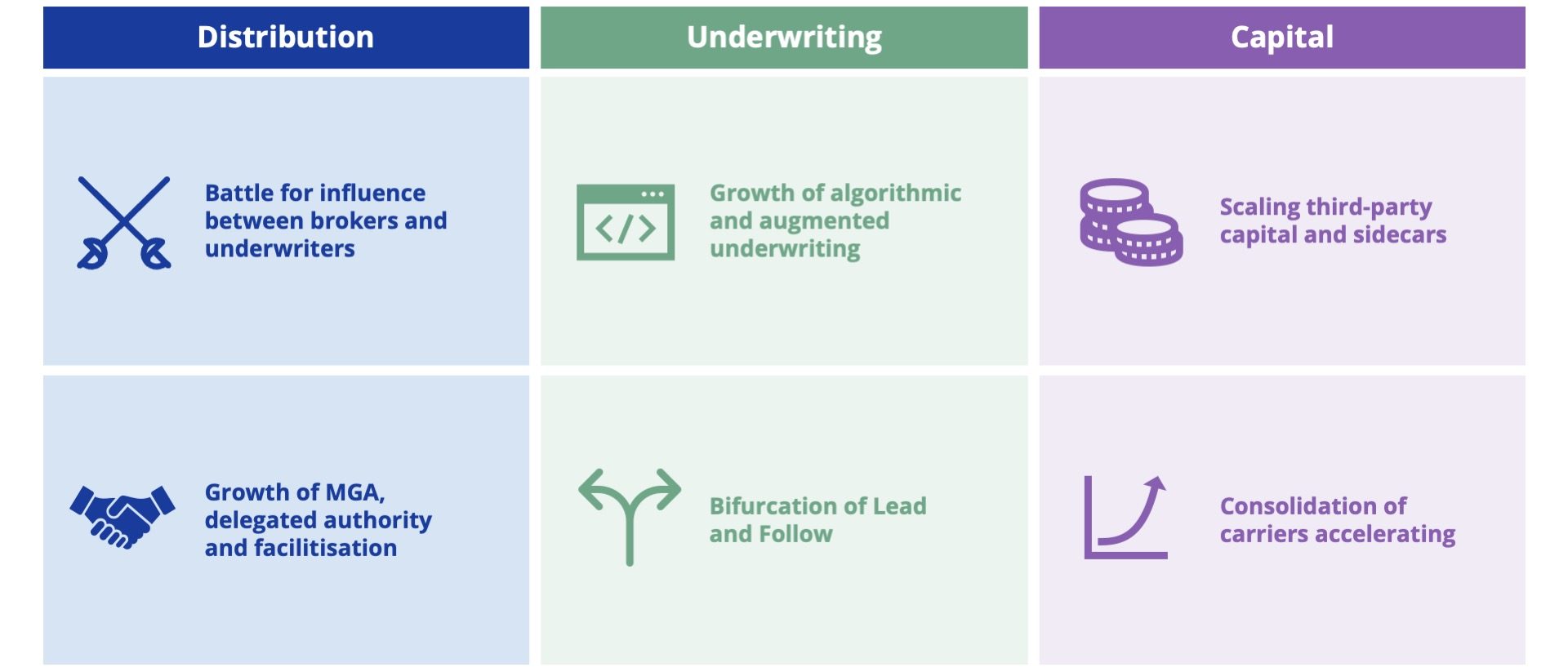
Since the last cycle, there have been several structural shifts…
Distribution: The battle for access is now a battle for control
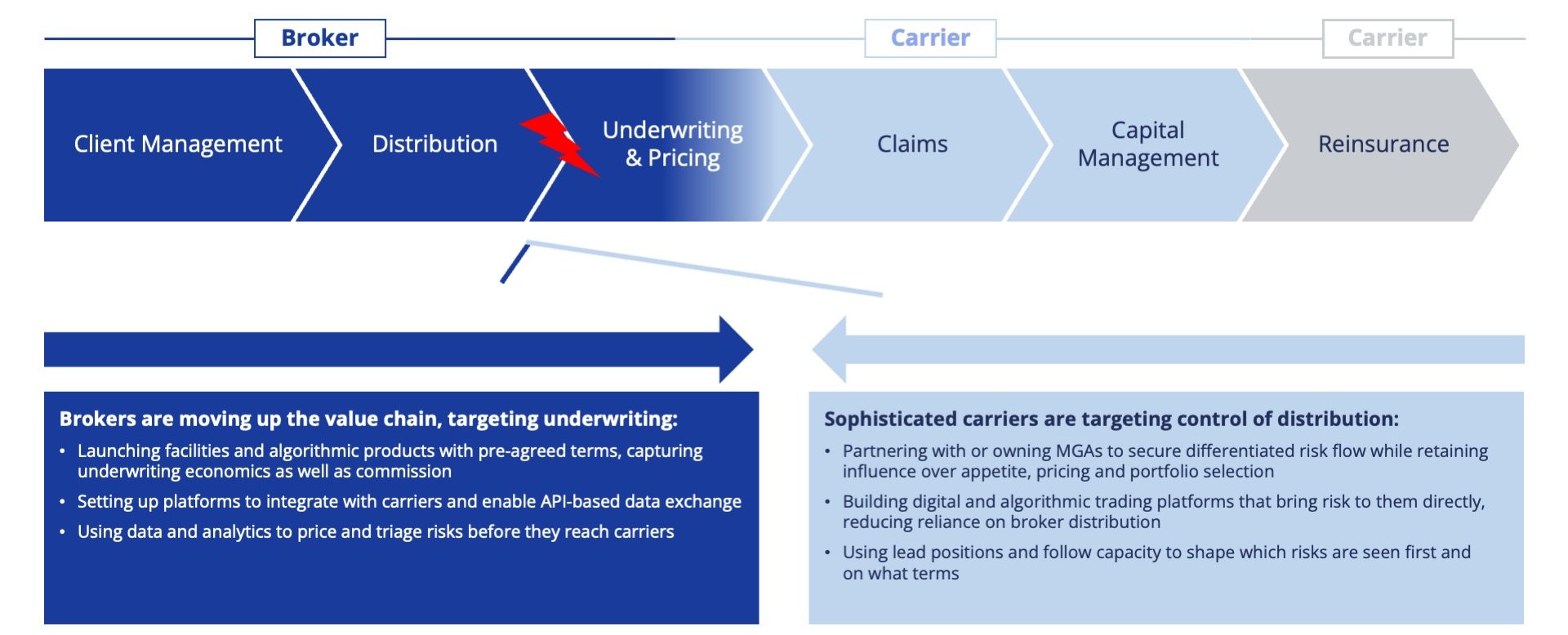
Brokers and carriers are increasingly competing to control the value chain. Brokers use facilities, algorithmic products and risk triage to capture underwriting economics. Carriers are pushing in the opposite direction, using MGA ownership, partnerships and digital trading platforms to secure risk flow and reduce dependence on traditional broker networks.
This has driven rapid growth in the size and scale of MGAs, delegated authority agreements and facilities. Carriers are increasingly competing to underwrite portfolios and form partnerships, rather than access individual risks.
The ability to manage these portfolios is becoming as important as securing access to distribution directly. Carriers need the data and controls to know what is being written on their paper, how it is performing and whether it still fits their underwriting strategy.
Simplified insurance value chain
Underwriting: Lead and follow are separating
Digital facilities and portfolio-follow models increasingly commoditise follow capacity by allowing capacity deployment behind selected leads without risk-by-risk underwriting. This creates a need to bifurcate your operating model: ‘True lead’ UW teams will differentiate through deep risk expertise and insight. Effective follow teams will focus on efficient risk assessment and portfolio selection. Trying to do both with the same operating model risks doing neither particularly well.
AI adds another dimension. As we argue in our 2026 AI CEO Agenda, it should be treated as a strategic capability, not as a collection of isolated pilots. This means connecting investment to the insurer’s edge: better risk selection, faster insight and scalable underwriting.
Capacity: The balance sheet is not the only route to scale
Acquisitions by carriers are increasingly moving beyond pure scale plays (e.g. RenRe’s deal thesis for Validus) to focus on combining complimentary specialist underwriting capabilities with broader distribution and market access, alongside the target’s financial resources. A good example is Zurich’s acquisition of Beazley: connecting Beazley’s underwriting expertise with Zurich’s distribution network, with cost and capital efficiencies on top.
At the same time, balance sheet acquisitions are no longer the only route to scale, as third-party capital and sidecars are helping insurers expand capacity, moderate retained exposure and generate fee income.
All this makes the middle ground increasingly difficult to sustain. Carriers that neither lead through distinctive underwriting, control attractive access to risk nor operate with structurally superior economics risk becoming interchangeable providers of capacity. The strategic challenge in a soft market is therefore not simply where to grow, but what the organisation will genuinely own.
3. Find and reinforce your edge
The starting point is to be clear about where you already have an edge, or could realistically build or reinforce one. We see three main sources: judgement, access and economics.
There are many ways to grow in soft market – many companies successfully did it in the last cycle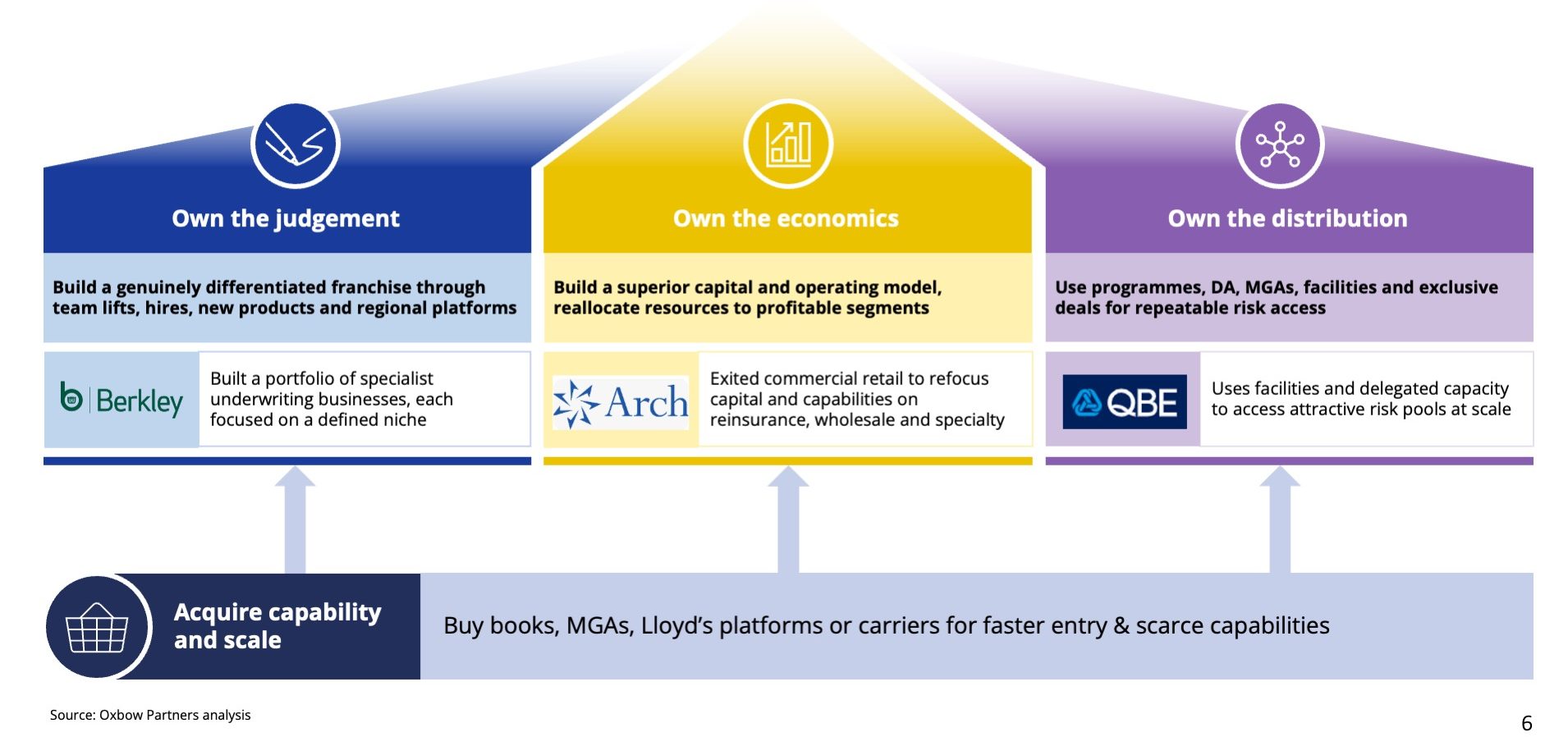
The point is not to (in most cases) transform the business, but to protect your edge and reinforce the strongest sources of differentiation:
- Own the judgement: Reinforce genuine lead franchises where you have distinctive underwriting expertise. This may be through team lifts, hires, new products and regional platforms; it also potentially includes expanding lead positions in existing classes and extending into adjacencies where underwriting expertise transfers
- Own the economics: Strengthen the operating and capital model behind the underwriting proposition, so that returns can scale with volume rather than depend on rising rates. This does not simply mean cutting the expense ratio. Protect investment in the underwriting, distribution and technology capabilities that create differentiation, while taking cost out of activities that do not. Match the cost base to the underwriting proposition and concentrate capital where returns are strongest
- Own the access: Deepen differentiated access to attractive risk pools through acquisitions, as well as programmes, delegated authority, MGAs, facilities and exclusive deals. Contracts with distribution partners should be seen as a central part of the underwriting strategy to ensure alignment with the broader portfolio strategy and sufficient oversight and control over risk performance
M&A can be used to develop these propositions: buy books, MGAs, Lloyd’s platforms or carriers to accelerate entry and acquire scarce capabilities. But acquisition muscle is not a differentiator. Paraphrasing Maslow, if the only tool you have is money, it is tempting to treat everything as if it were an acquisition target. Those that do not have a clear deal rationale and integration plan risk overextending the organisation operationally and financially and not realising the expected quantitative and qualitative benefits.
The goal is not to be best at everything. Every carrier needs credible underwriting, economics and access, but winning requires being genuinely distinctive in at least one. Leadership teams should be explicit about where that edge lies and invest disproportionately to protect or strengthen it.
Conclusion: Build the business you want at the next market turn
The wrong strategic soft-market questions are “How do we preserve our hard-market growth and profitability?” or “How far should we retrench?”. The better question is “Who do we want to become by the time the cycle turns?”.
Soft markets expose what rising rates can hide. The winners will reinforce their core, choose growth investments and exit business that does not support their strategy. Those that cannot develop a consistent underwriting edge, differentiated access to attractive risks or structurally superior economics risk becoming increasingly interchangeable and less special.
The cycle will turn again. The opportunity now is to make sure that, when it does, the business is stronger and more distinctive than the one that entered the soft market.
About the author
Miqdaad Versi, Partner. Miqdaad is a Partner in the London Office. He advises management teams at global specialty (re)insurers on strategy, transformation, M&A and operating model engagements. He authored Oxbow Partners’ 2024 report on Generative AI and has since worked with executives, leading engagements on a wide variety of AI and claims transformation programmes. He spends a lot of his time with clients in the US, Bermuda and the UK. Miqdaad started his career at Oliver Wyman and, before joining Oxbow Partners, held a range of operating and advisory roles, including leading the transformation of a small business in which he invested.