Before the bankers call
26 May, 2026
Why do insurers need an M&A strategy, not just an M&A appetite?
Study after study puts the failure rate of mergers and acquisitions somewhere between 70% and 90% (Source: Harvard Business Review, Lev & Gu (40,000 deal analysis), CohnReznick). Insurance is no exception. ACORD’s analysis of the largest carrier deals of the past decade found that only 52% created long-term shareholder value, and among reinsurers and multiline buyers, three quarters of recent transactions destroyed it.
All too often, once a deal is live, momentum takes over: timelines compress, competitive tension builds, and the strategic rationale gets retrofitted around a target that may or may not actually fit.
Intact’s acquisition of RSA in 2021 shows how M&A can deliver when it is tightly anchored in strategy. Intact wanted to scale domestically and expand internationally into specialty commercial lines, gaps it could not fill organically. Its joint bid with Tryg allowed it to acquire only the businesses that fitted, while sharing execution risk. Integration was planned from the outset, and synergies were delivered ahead of schedule. As a result, the transaction proved immediately value enhancing and is on track to deliver around a 20% uplift in net operating EPS.
With the onset of the soft market cycle, executives are likely to have more pitch decks land on their desks. Executive teams need clearly defined strategic objectives and guardrails for M&A to ensure they source and strike on the right deals and create value for their shareholders. This is M&A strategy.
Please get in touch if you wish to discuss your strategy with us.
Step 1: Start with corporate strategy, not acquisition targets
An effective M&A programme starts with enterprise strategy – a clear articulation of your ambition, where you want to play and how you intend to win. How big do you want to be? Which customer segments, lines of business, geographies do you target? What competitive model are you building: scale, specialisation, diversification, or some combination?
Without this, you cannot have an effective M&A strategy.
Step 2: Identify what organic growth cannot solve and where M&A could add value
With strategy set, the question becomes simple: what cannot be delivered through organic growth? Do you have capability gaps (for example underwriting expertise, technology challenges) or growth gaps (lines or geographies where you want to grow faster than the organic rate allows)? Is M&A the right tool, or are other options such as team lifts preferable?
This provides parameters for what any acquisition target needs to deliver. Teams should not waste time reviewing companies that do not substantially tick these boxes.
Step 3: Define your acquisition appetite
A clear strategy tells you what you are looking for and how an acquisition will create value. Next you can define a more specific appetite for acquisitions, allowing you to move from ‘this asset is available at an attractive multiple,’ to ‘we have a specific gap which this asset or group of assets are the fastest credible route to closing.’
Guardrails define the universe of suitable deals without getting into individual targets, for example minimum and maximum GWP, geographic scope, lines of business and financial parameters around maximum price multiples and minimum returns. A deal outside these parameters should be declined at first review, not subjected to months of distracting deliberation. In reality, most deals will include some business that is not within your appetite; there will be trade-offs and it is best to have a view of how you will deal with this before the process starts. For example, can you split the business with a partner as Intact and Tryg did with RSA?
Fit criteria allow you to assess targets within the guardrails. A structured scorecard should cover strategic alignment, cultural compatibility, integration approach and delivery risk. The scorecard’s real value is forcing an explicit conversation about where a target scores poorly and whether that is acceptable or disqualifying.
Red lines are pre-committed conditions that end the deal regardless of how well a target performs on every other dimension. Valuation discipline and reserve adequacy are the two most common places where this commitment breaks down – acquirers convince themselves they can manage the risk post-close and often spend years regretting their optimism.
Step 4: Decide how you will integrate and establish delivery capabilities
Integration is a strategic choice and should be considered as part of your M&A strategy.
Different transactions require different integration approaches, shaped by the relative size of the acquirer and target and the degree of business model overlap. That choice affects what you can credibly pay, what you can promise management, and whether your value creation plan is realistic.
Executives also need to be honest about integration capability. Insurance integrations are inherently complex as two regulated organisations are brought together with a need both to realise revenue and cost synergies, and also to trade without disruption on day 1.
Companies need to be realistic about their integration capabilities and consider how they will organise when the rubber hits the road. Who has the right experience and skills to lead the integration? How will we organise? Where will we need external support?
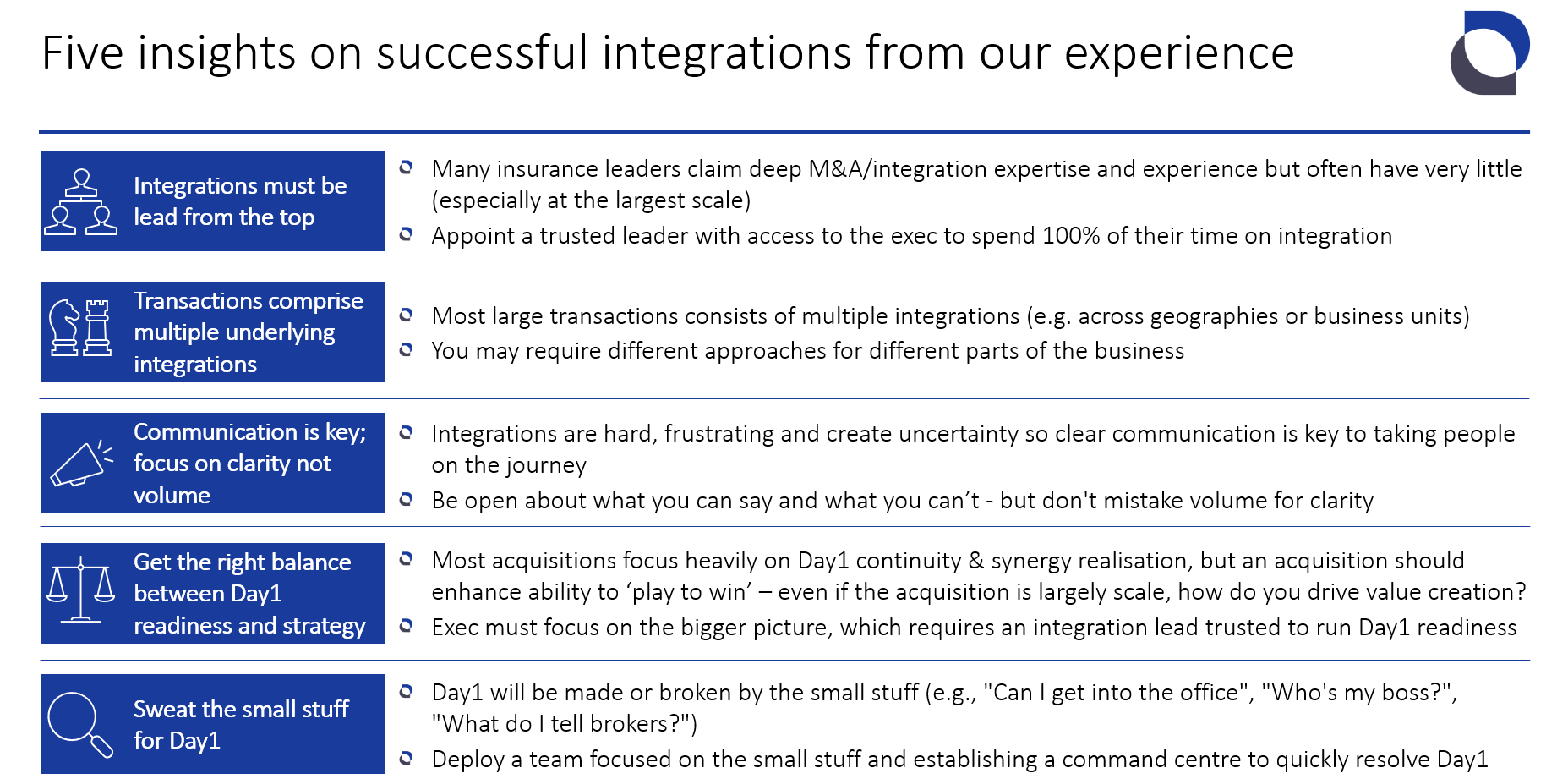
Once the deal is signed, integration starts and there is little time to answer all of these questions.
Step 5: Build the discipline and credibility to execute
An effective M&A strategy needs to translate into consistent behaviour when deals emerge. That requires clear governance and proactive origination, not just ad hoc responses to live processes.
Executives should be explicit about ownership and decision-making. Who is responsible for origination and deal management? How are decisions escalated and challenged when timelines compress? Where does the authority to stop a deal sit? Without clarity, momentum fills the vacuum and discipline erodes.
Origination should follow from this foundation. In markets where high-quality assets are scarce, the most successful acquirers are proactive, building relationships and credibility with potential targets well before a process starts. For many private and founder-led businesses, outcomes matter as much as price. Buyers that can articulate a clear strategy, a credible integration approach and a compelling future for the business and its people are better placed to win competitive processes than those relying solely on the size of the cheque.
Conclusion: The bankers’ calls are coming
Insurers who have done this thinking in advance will evaluate deals faster, negotiate from a position of clarity, and integrate with a plan. They will also say no more quickly and more confidently – freeing management to focus on running the business and identifying attractive targets.
Those who have not will continue to acquire based on hope rather than strategy. The data suggests they will continue to disappoint.
Now is the time to pressure-test your M&A strategy – before a process starts and management attention is consumed by a live deal.
Oxbow Partners works with insurers at each stage of the M&A process, from strategy and target screening through to integration planning and value capture. If you would like to discuss how this framework applies to your business, please get in touch.
About the author
Oliver Watts is a Senior Manager at Oxbow Partners.