The long tail of a hotter Britain: why subsidence is becoming a board issue
16 September, 2026
2026 looks set to be the second consecutive subsidence surge year, a relatively rare pattern which was previously observed 30 years ago. The evidence from the last few years suggests that subsidence can no longer be treated as a one in five-year event. If subsidence becomes an annual issue, it increases the need for insurer boards to take an active stance and either pull back or lean in.
Successive heatwaves drive back-to-back subsidence surges
In recent years home insurers have had to think about climate risk more diligently. Following the UK’s hottest summer on record in 2025, 2026 has set new heat records of its own. [1] One of the immediate concerns is back-to-back years of elevated subsidence activity, with claims development flowing into 2027 and rebuild-cost inflation amplifying severity. Importantly, subsidence related risk can no longer be treated as an exceptional event. It is becoming part of the annual operating context for home insurers, with direct implications for exposure management, claims readiness and future performance.
Figure 1
Soil Moisture Deficit depth has reached levels indicative of a subsidence surge year
Soil Moisture Deficit depth by week of year: surge years (2018, 2022, 2025), 2026 to date, and 2024 as a normal-year reference
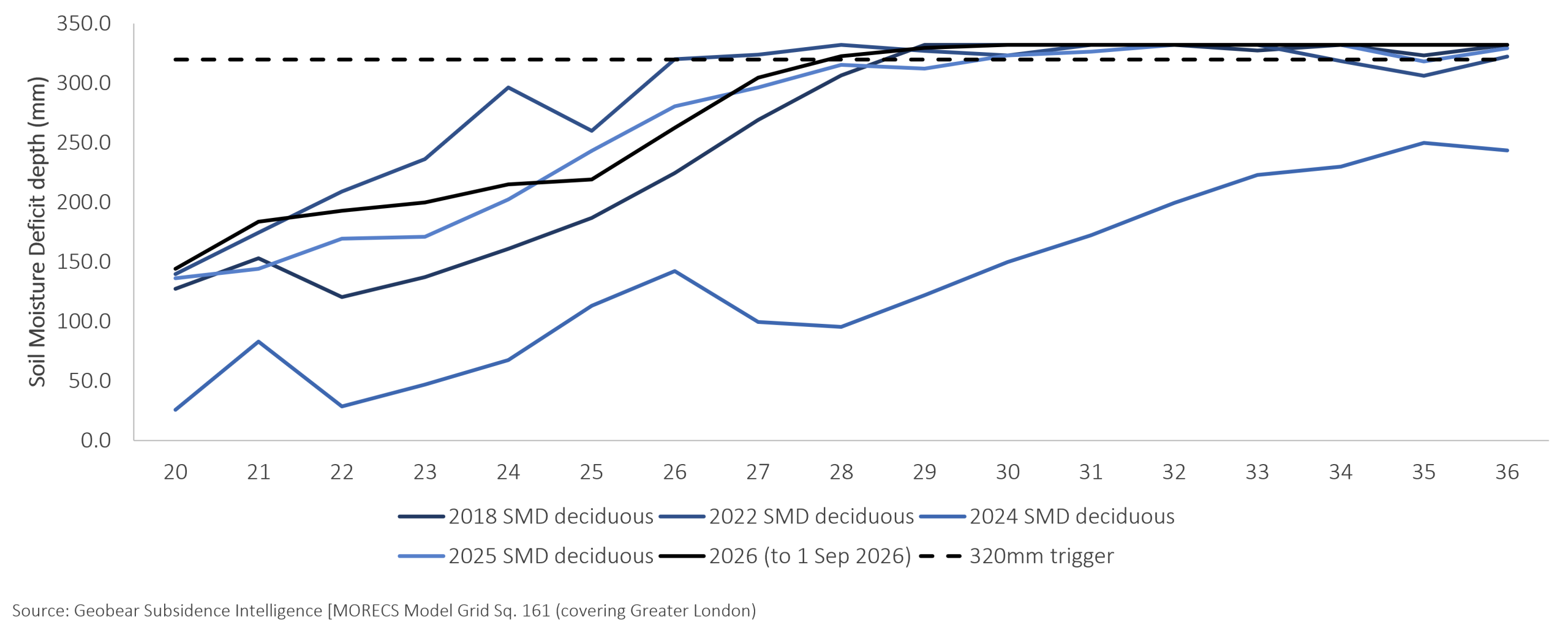
2026 is tracking the same soil moisture deficit (SMD) path as the surge years of 2018, 2022 and 2025. In Figure 1, the 320mm line matters because it marks the point at which soil becomes critically dry, the equivalent of 320 litres of water missing from every square metre of ground. At that point, clay soils shrink, foundations move and buildings get damaged.
The gap between surge years is closing
The interval between surge years is shortening. 2018 to 2022 gave the market a three-year gap. 2022 to 2025 gave two. On current soil moisture readings, 2025 to 2026 gives none-at-all.
That compression removes the recovery window carriers have relied on. A three-year gap allowed surge-year claims to settle, rate action to earn through, and the loss adjusting and contractor supply chain to reset before the next event arrived. Back-to-back years allow none of that.
Properties placed under monitoring in 2025 will still be open when 2026 notifications land; the same engineers and contractors will be asked to handle two cohorts at once; and rating action taken in response to 2025 will not have fully earned before the next accumulation begins. The supply chain is being put under greater pressure, particularly in the retail market where suppliers are trying to process thousands of claims causing performance issues. This, in turn, increases the demand for specialists.
The practical consequence is that subsidence can no longer be underwritten as an occasional event absorbed across the ‘good’ years. It has to be planned for as a recurring feature of the book.
Figure 2
Average subsidence claim size is outstripping CPI
Year-on-Year comparison of Average subsidence claim size and CPI applied claim size, 2017-2026(Q2)
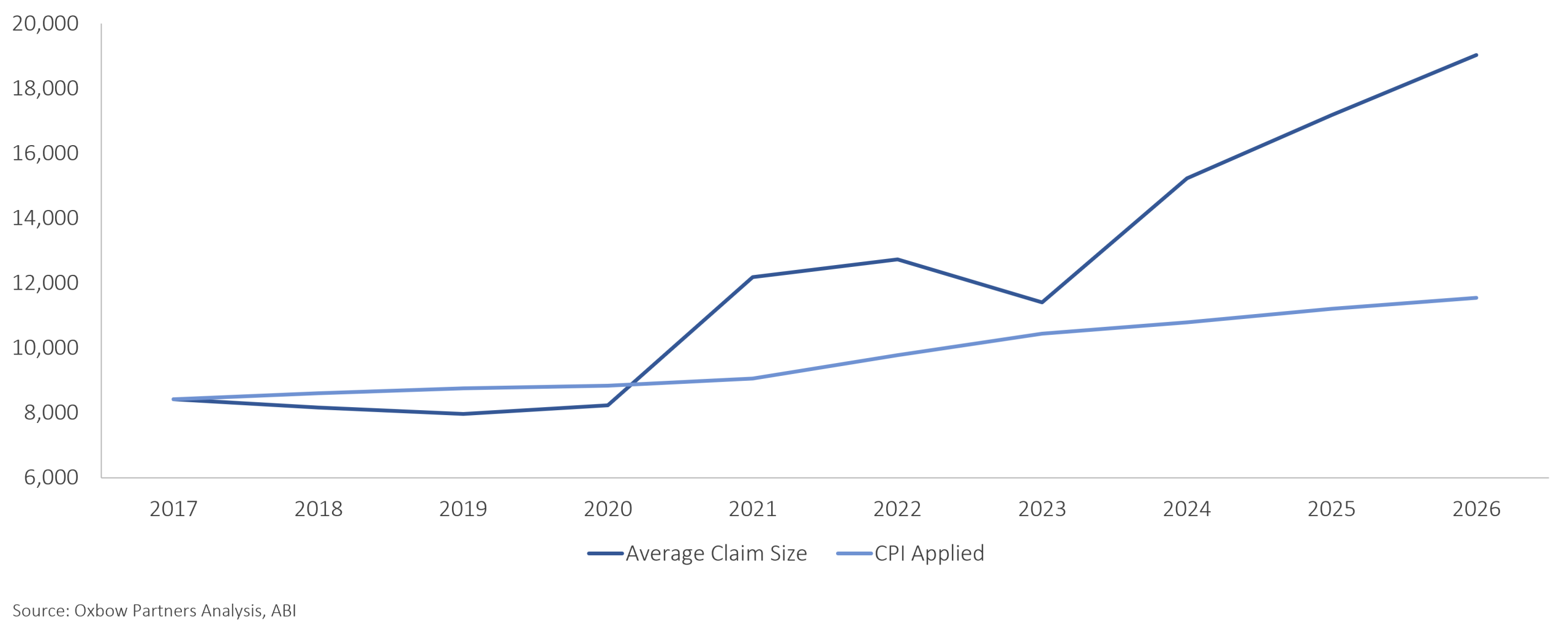
Figure 2 shows average subsidence claim size of £19k running well above CPI. Three pressures sit behind that gap: raw material availability, labour availability and increased claim severity due to multiple years of impact. The resources and labour required to repair damage have both increased due to inflation and supply pressure respectively. The underlying claim severity has also been impacted by properties being exposed to multiple events, increasing the likelihood of underpinning or rebuilding which can treble the claim cost. This is not likely to ease through 2027, insurers need to revisit pricing now rather than waiting for the 2026 cohort to settle.
Insurer boards have decisions to make
The potential for subsidence to be an annual event sharpens the decision making required for insurers.
Should we write subsidence at all?
Subsidence risk is highly localised around London and the South-East where clay soil is prevalent. Factors such as soil type, nearby trees and property characteristics mean that only a small proportion of homes are truly exposed, yet the cost is often spread across the wider insurance portfolio. Faced with increasingly regular claims, insurers need to make an active decision on whether or not to write subsidence risk.
Do we have enough data to write effectively?
Whether you choose to write subsidence risk, property level data is a must. Insurers with property-level soil and vegetation data can target premium increases on genuinely exposed homes or choose at an individual level which properties to avoid. Those relying on postcode-level pricing will continue to cross-subsidise high-risk properties with premiums collected from lower-risk neighbours affecting the overall market capture with mixed pricing.
Should we lean in and become a specialist?
Some subsidence claims can remain open for months or even years while movement is monitored. Where cases progress to ‘underpinning’, costs rise sharply. During surge periods, increased demand for adjusters and contractors pushes both repair and handling costs higher. There is scope for insurers to become specialists in subsidence claims. This could provide a competitive advantage as others struggle to cope under the challenge of repeated surge years.
Conclusion:
2026 may prove significant not because it is exceptional, but because it may be the new normal.
This turns subsidence from a claims issue into a strategic decision. Insurers must determine whether to exit the risk, reprice it, or develop a competitive advantage through superior underwriting, data and claims capabilities.
Boards need to make an active decision on what their approach and appetite is for subsidence risk or else risk walking into significant exposure that they have not priced-in.
[1] BBC, Summer 2026 on course to be UK’s hottest on record, says Met Office, 2026
About the authors
Paul De’Ath leads the Oxbow Partners Market Intelligence team. Prior to joining Oxbow Partners Paul spent nine years as an equity research analyst covering all aspects of insurance across the UK and Europe. He started his career as an accountant and also spent some time in industry at Standard Life.
Tony Sault recently joined Oxbow Partners as a Partner with a remit to focus on the Retail Personal and Commercial Lines markets, advising insurer and broker clients on strategy and transformation. Tony started his career over 30 years ago at RSA before moving into consultancy where he spent almost 20 years at EY and Chaired the annual EY UK Motor and Home Results Seminars.