Reinsurance strategy in a softening market
24 July, 2026
How can you position for the next hard market?
The reinsurance market is defined by a handful of large names. Behind them sits a long tail of smaller companies, often the reinsurance subsidiary of large diversified groups. Most have strong relationships and are technically credible – but have few meaningful levers to influence their short-term outcomes.
That’s a problem because reinsurance is a cyclical business. In the good times it is highly profitable, and group CEOs love the top line growth and dividends. When markets are soft, the board wonders why they have this mysterious business that nobody fully understands in the group. Reinsurers need to be clear on the value they provide.
This is particularly acute for group-owned reinsurers.
It is clear that we are at – or have passed – a turning point in the cycle. Compounding a challenging pricing environment, reinsurers are also facing higher costs of competing due to rising technology and data investments, and must maintain relevance as traditional and ILS capital floods the market. The ageing demographic profile of the industry adds urgency to the transformation agenda.
Property CAT RoL Index¹ vs. Casualty Reinsurance Price Index²
(Index 2011 = 100)
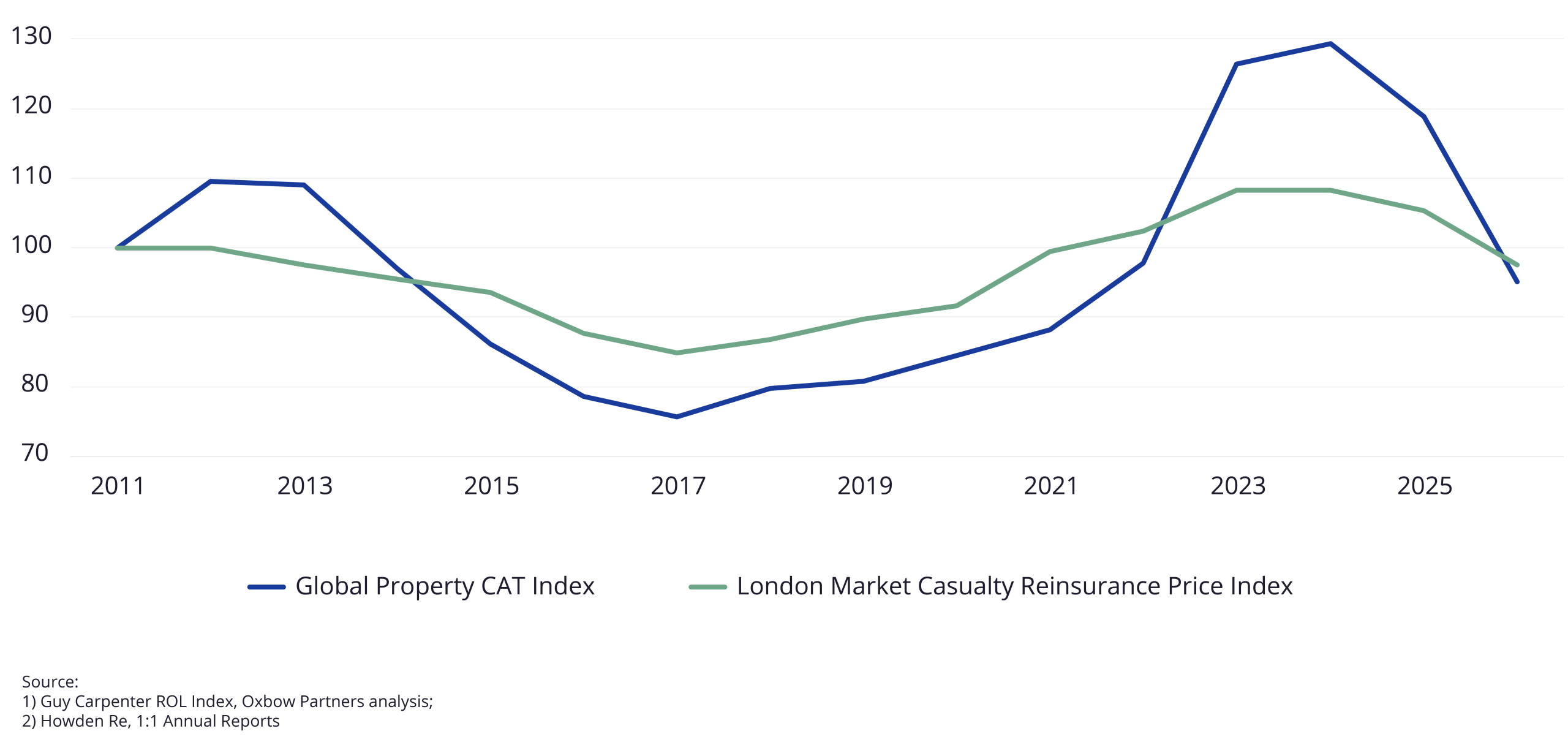
As reinsurers navigate into a soft market, the instinct is defence. “Cycle management” meetings are focused on where exposure should be cut and downside can be protected. Our research shows that this is the wrong instinct.
Instead, reinsurers need to use the soft market to position for the next hard market. Our research shows that the most successful reinsurance companies push for growth through the cycle, and that restraining growth in the soft market is not a formula for superior cross-cycle performance.
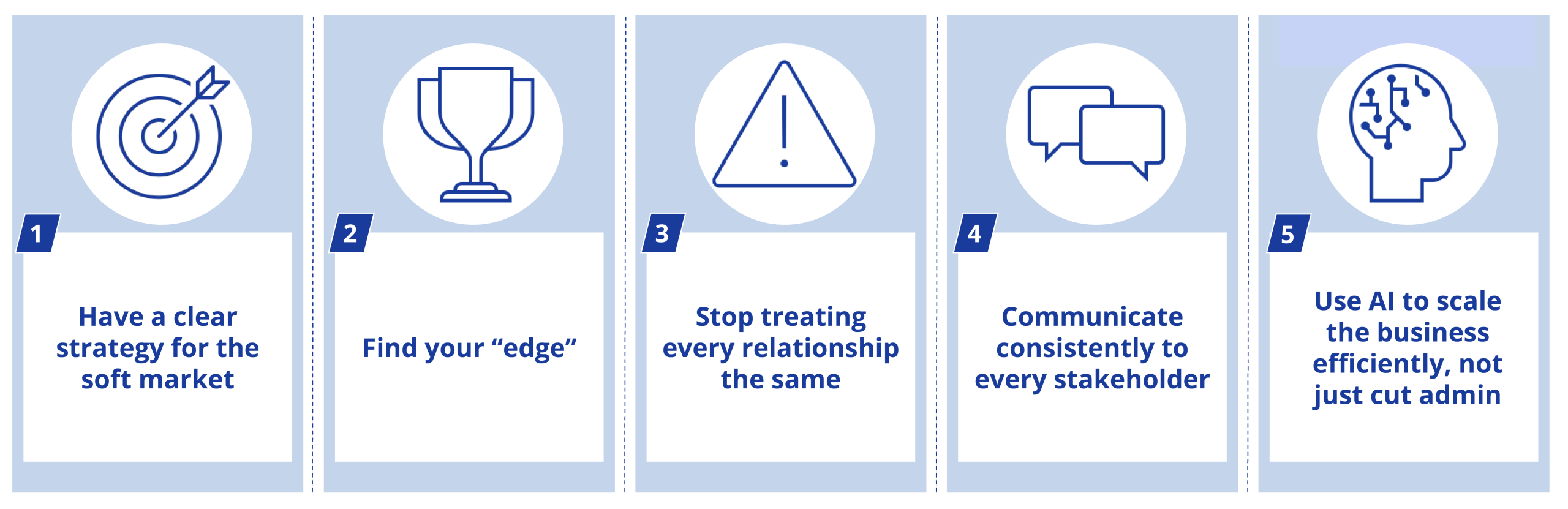
Reinsurers make their money in the hard market. The soft market is when outperformers get prepared for the next hard market, and underperformers retreat. Outperformers over the next cycle will focus on five key themes.
Five actions for reinsurers to win
1. Have a clear strategy for the soft market
We see the same game play out whenever the market turns. Reinsurance CEOs assure the trade press in interview after interview that they will maintain pricing discipline and not follow the market down. Then Monte Carlo happens and 1/1 approaches and carriers renew almost all of their book at market rates.
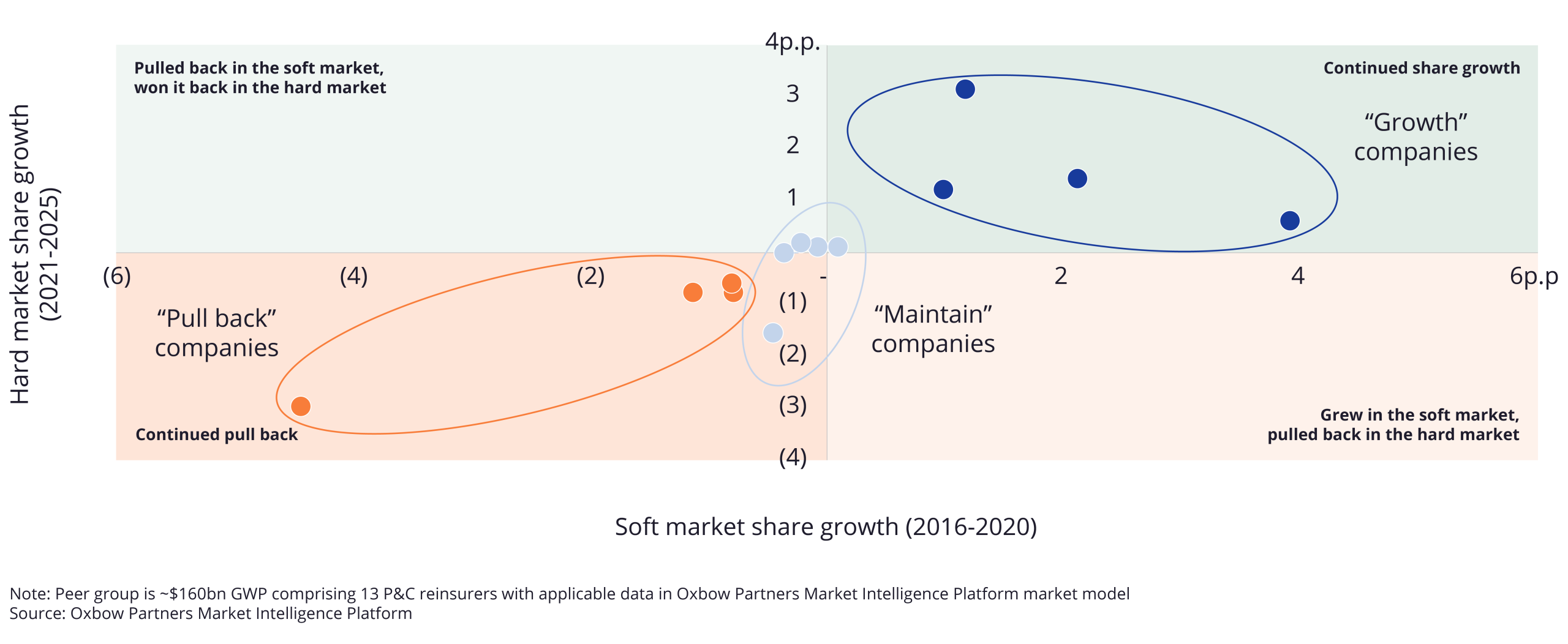
Whilst contradictory, our analysis shows that this is a smart strategy. Data from the Oxbow Partners Market Intelligence Platform shows that no P&C reinsurance company has managed to shrink in the soft market and grow in the hard market in the last decade. The four companies that grew strongest in the hard market also grew the most in the soft market. Those who shrank most in the soft market were not able to grow again in the hard market.
Soft vs. Hard market: Market share change in each period
2016-2020 & 2021-2025, p.p., End – Beg. GWP Market share, P&C Re
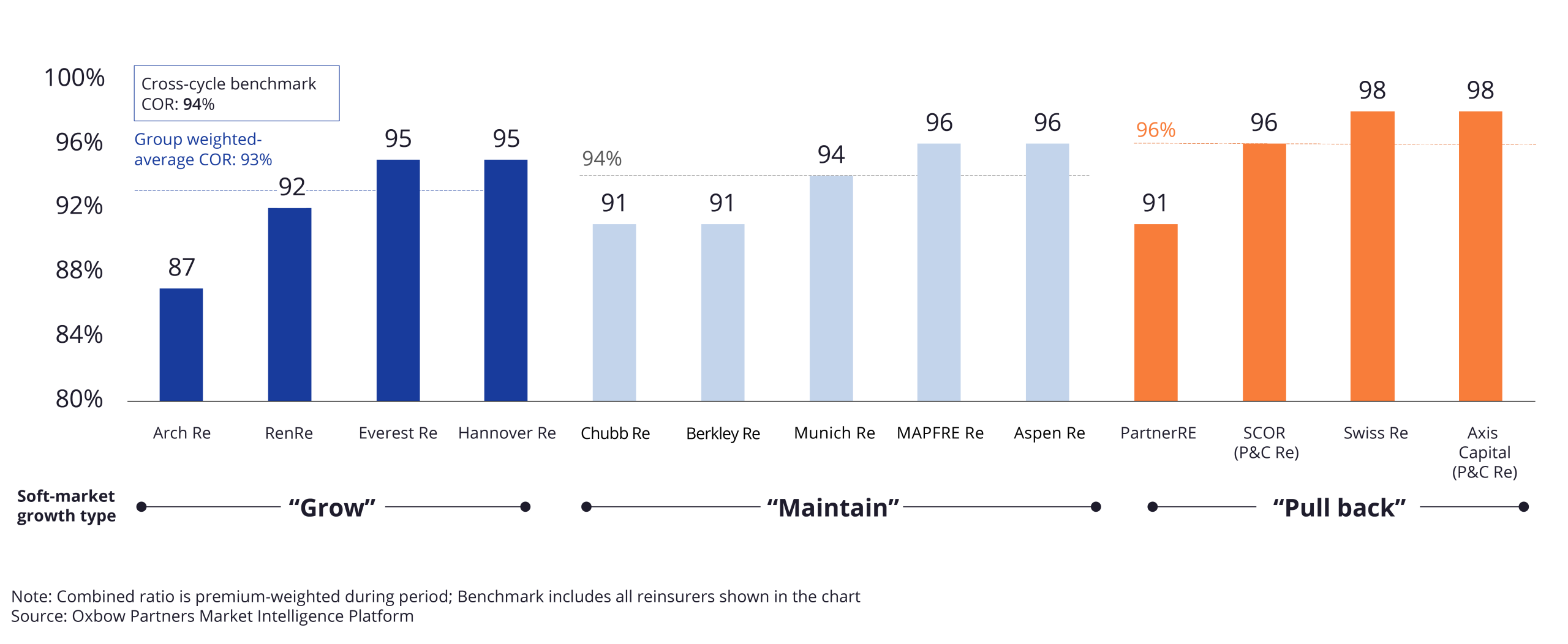
We also – with all the caveats of limited data in this market – observe that those companies which grew through the soft market had a better average underwriting performance through the cycle than those which held or shrank their positions (although we acknowledge the small sample size and company-specific strategies that have significantly impacted their performance).
Cross-cycle Combined Ratio (COR) of different soft-market growth type¹
2016-2025, %, P&C Re, ordered by growth type & cross-cycle COR
The obvious implication is, therefore, that CEOs and CUOs should take a long-term view of their business. Pulling back now protects this year’s result, but the lines and relationships you give up are the ones you need when rates recover. What is the value of a renewal right in your client base? What are you prepared to invest in the short term to win across the cycle? This choice is particularly acute for smaller players as a 3% treaty share does not give much room for manoeuvre.
These are questions that need to be answered with the group executive, which needs to understand trade-offs and the financial profile of reinsurance, and potentially fund an investment in the platform in the coming years.
2. Find your “edge”
In a soft market, generic capacity gets squeezed first. Reinsurers with a clear “edge” have a better chance of staying relevant, keeping access to attractive business and defending long-term economics.
We have noted in previous articles about reinsurance that few players have a true “edge”. Munich Re and Swiss Re are the “premium” players, Hannover Re is the “low cost one”, RenRe are the “property cat people”. But the list quickly trails off.
“Edge” is critical because it is what drives outperformance. It is the story to the market and staff, the galvanising reason why your company is better than others. It’s what drives access to the best risks.
Reinsurers should be clear about where they play and how they win with clients. For large reinsurers “edge” is a difficult concept as they participate across most products in most geographies in a largely intermediated market. For smaller reinsurers it can be easier – and is certainly more important – to script a compelling “edge” story.
For example, smaller reinsurers do not have the complex bureaucracy of bigger players. Responsiveness coupled with expertise in a particular niche could be a strong differentiator, particularly amongst smaller cedents who do not command the same service from a large reinsurer.
What is your “edge”? Is it a geography, product or service element? Do your cedents see the “edge”? Would your employees all say the same thing?
3. Stop treating every relationship the same
Different cedent groups want different things from their reinsurers. Are you clear on why your clients come to you? Technical pricing, bespoke analysis and senior access can matter, but often they do not. Many clients want simpler things from their tail of reinsurers: consistent capacity, easy engagement, reliable behaviour, no surprises.
The follow-on questions are then tough for many: are you able to provide what your cedents want profitably? Are you willing to drop certain elements of your service proposition if they don’t make sense financially?
Smaller reinsurers have an opportunity to offer service levels that the larger players cannot (or will not). Though the challenge is that they often want the most from smaller reinsurers. So the reinsurers need to make a choice. Is the relationship, at this level of service, viable? Put another way: is visiting a cedent once a year for $100k premium really worth it?
The key is transparent data and a deliberate approach. A well-run low-touch relationship can still count as a good relationship so long as you have been explicit with the client that this is what you are offering. Over-serving a client who only wants reliable capacity burns scarce underwriting and analytical time for no return.
Are there innovative ways to capitalise on your good relationships? We wonder whether the consortium model in the London Market or an explicit fee for service from smaller cedents might be interesting reference points.
4. Communicate consistently to every stakeholder
Ambiguity is expensive in any market. In a soft one, it is dangerous as relationships that took years to build can be damaged.
Each stakeholder is asking a version of the same question. Cedents want to know if you will follow the market or want to send a signal. Brokers want to know if it is worth bringing you opportunities. Underwriters need to know when to push, hold or walk. Shareholders want confidence that growth will not come at the expense of profitability, capital or dividends.
The questions are different but pull in the same direction, and require a story that holds for all of them at once. That means a single, consistent line – where we are growing, where we are disciplined, the role we want to play, and what we will not do – expressed differently to each audience but never in conflict.
To some extent, larger reinsurers can get away with a bit of misalignment. The market is used to their contradictions and they are too big to sulk at.
Smaller reinsurers have less flexibility. Their messaging is to a smaller audience and their behaviour needs to be more aligned to those messages. When boardroom strategy, messaging, and underwriting behaviour do not line up, the business looks uncertain at exactly the moment when relationships need to be protected.
5. Use AI to scale the business efficiently, not just cut admin
As we argue in our AI paper, AI is strategic and core for reinsurers: the opportunity is to build new sources of competitive advantage and new business models. Efficiency gains will be large, but will commoditise over time. Lasting advantage in reinsurance compounds through judgement on complexity.
Reinsurers need to be clear about what a reinsurer will look like five or ten years from now. How will technology impact the “shape” of the reinsurance company of the future? How can technology allow reinsurers to grow the top line without a proportional increase in cost?
AI changes the game for many of these considerations because standardisation and scale are no longer pre-requisites for technology impact. Instead, with the right information infrastructure, more employees can have better insights and make better decisions autonomously. In reinsurance, this comes through in complex, unstandardised work like treaty wording analysis, submission triage, exposure aggregation – the kind of judgement-adjacent tasks that could only be done by a person. AI will allow reinsurers to scale while remaining lean, both in headcount and in bureaucracy.
Second, reinsurers can test AI opportunities in ways larger companies cannot thanks to their generally smaller and leaner operating models. Our AI paper describes “domain pods” – teams comprising complementary skills and will be focused on a capability that delivers sustained competitive advantage. Crucially, these pods will both change and run the domain.
Pods could be a client domain (e.g. private equity), product domain (e.g. W&I insurance) or capability (e.g. structuring and placement). The defining feature is that shared data and expertise are critical enablers of the domain and that the domain is critical to creating sustainable competitive advantage.
The watch-out is discipline. Every AI initiative has to connect to how you build a lasting “edge”. Otherwise, you end up with a drawer full of unconnected POCs that impress the board for a quarter but fail to compound.
Where does AI fit your “edge”? Which part of your operating model would you rebuild if scale were no longer the constraint? And are you experimenting where it is safe to fail, or bolting pilots onto the book that pays the bills?
Conclusion: deliberate choices
The winners at the top of the next market will be those who maintained a winning mindset during the soft market and did not retreat away from long-term performance. They will have used the next five years to find and explain their “edge” to stakeholders, and build the assets that allow them to win.
About the authors
Oliver Watts, Senior Manager at Oxbow Partners & Eva Song, Consultant at Oxbow Partners.